
This article was originally written in Traditional Chinese. The English version was translated automatically by AI. Read the original.
Why does talking about a problem so often turn into talking about people? A cold war in a family apartment building's stairwell reveals why teams struggle to stay focused on the issue, and how to help everyone shift from facing off to standing side by side, looking at the problem together.
In one apartment building lived several branches of the same extended family. The ground floor was shared space, and of the units upstairs, some were occupied by family members and some were rented out. Recently, one of the units got a new tenant, and the stairwell quickly filled up with his personal belongings.
Two older relatives living in the building worried that in an emergency, all that clutter would block the way out and put people at risk. They first spoke to the tenant directly, only to be told, "The landlord hasn't said anything. What gives you the right to tell me what to do?" So they raised the matter in the family group chat, hoping the actual landlord would step in and deal with it.
The issue itself wasn't complicated: the stairwell is an escape route, piling it with stuff is a safety hazard, and because the building had no formal management committee, the tenant believed only the landlord had any say over him and the neighbors should mind their own business. The messages in the group chat really did revolve around just these points.
But the landlord, a mother who wasn't good with conflict, read an entirely different story. She began complaining to her family: "They're ganging up on me again. They've always bullied me." Her family urged her that if she felt this way, she should talk it through with her relatives in the group chat. Her reply: "If you actually paid attention to what they've been saying about me in the group, you'd know they've been targeting me all along."
What would you have done?
In fact, since more than half the building was occupied by members of the same family, all it would have taken was for everyone to agree that the stairwell must be kept clear, with no personal belongings allowed, then post a notice in the elevator and actually enforce it. No need to make it personal, and no need for any bad feelings.
But in this story, a matter about a stairwell turned into a cold war over "long-standing grudges and emotions."
Things Are Always Done by People
Plenty of people will find this scenario all too familiar from work.
A project runs late, and in the review meeting someone says, "The process at this stage needs adjusting." The colleague responsible for that stage immediately feels singled out. A new policy isn't gaining traction, and someone says, "We need to reassess our approach." But the manager who introduced the policy hears, "Your decision was wrong."
In Taiwan, we often talk about "focusing on the issue, not the person," yet we rarely manage to do it. It's not that people are unreasonable. It's that things never exist in a vacuum: every past event was handled by someone, and every problem that needs solving needs someone to solve it. The discussion may be about "a thing," but the "person" who handled it can hardly help feeling that they've been put on trial.
That's exactly what happened with the mother. Her relatives were talking about the stairwell, but because she was the landlord, "there's a problem with the stairwell" sounded to her like "why can't you keep your tenant in line?" On top of that, a great many "feelings" from the past had never been properly expressed or discussed, and she had instead come to treat them as "facts." So she quickly read this situation as yet another instance of being targeted and attacked.
Why Reasoning Doesn't Work
At the time, her family tried to reason with her: your relatives are talking about a safety issue, not attacking you. But none of it got through. If anything, it made her feel that even her own family wasn't on her side.
Once people feel attacked, their first instinct is to protect themselves. At that point, no amount of reasoning helps; it all just sounds like another round of blame. And the more eager you are to prove "I'm not targeting you," the more cornered the other person is likely to feel. Often, the only thing to do is let emotions cool first, then return to the issue itself once both sides are ready.
The workplace is no different. The more seriously a review meeting is run and the more detailed the explanations, the more defensive the people under review may become. In the end, everyone spends a great deal of time explaining, clarifying, and deflecting blame, while the real problem goes unsolved.
Taking the Issue Off the Person
If "the issue" and "the person" get stuck together because things are always handled by people, then perhaps we can come at it from another direction: create a situation in which the link between the issue and the person is temporarily removed or weakened.
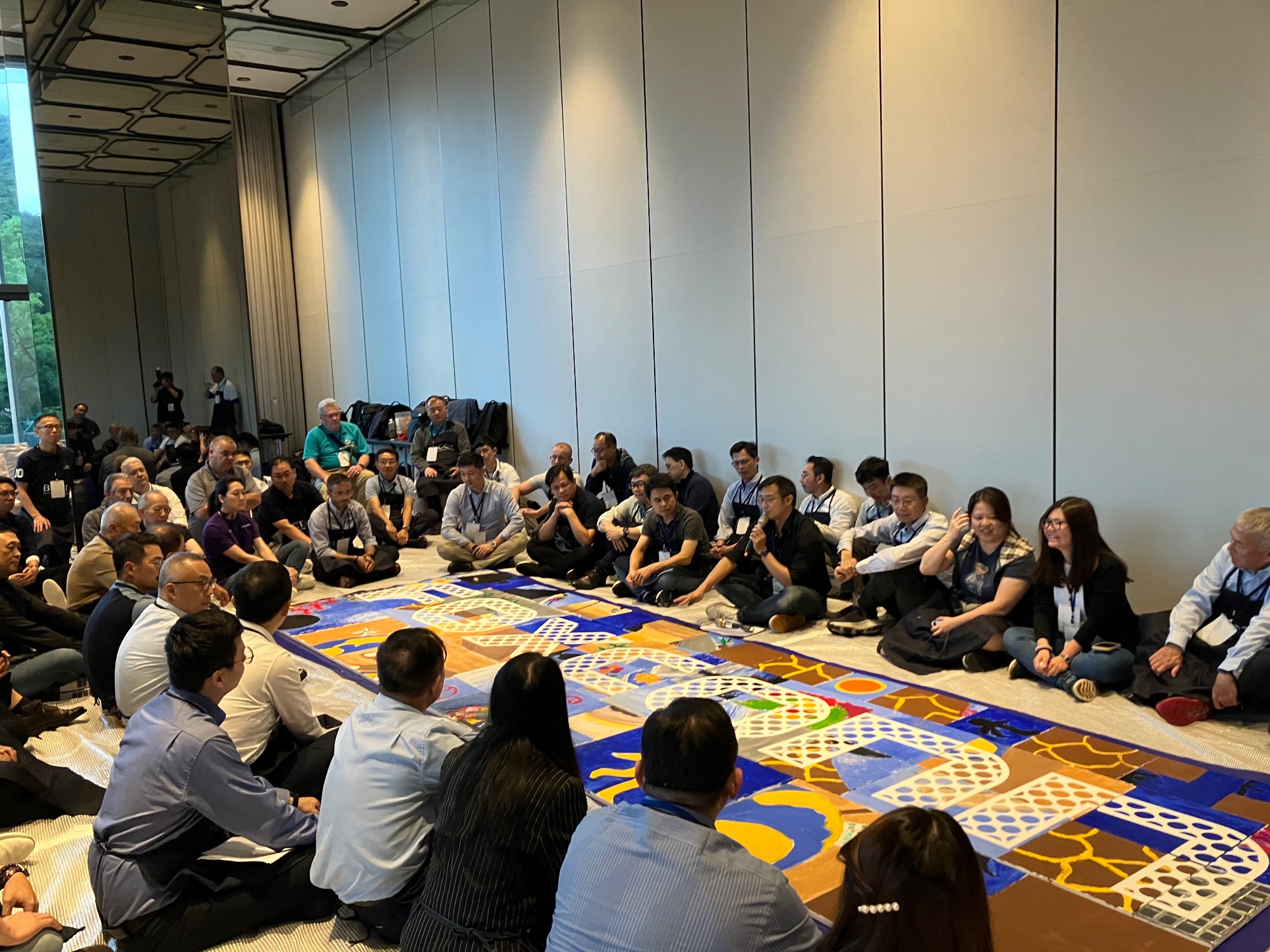
For example, when BCCT designs team activities, we often use situational shifts to create a parallel world outside the workplace. Within the activity, the work in team members' hands takes the form of a visible, physical object, most commonly a single painting that the team creates together out of multiple canvases.
We deliberately build into the activity many of the same situations that come up at work: information gaps, differing interpretations, resource allocation, friction over division of labor, and even conflict. So the creative process never goes entirely smoothly, just like a real project.
But when it's time to discuss, there's one key difference from a typical work setting: the painting is placed in front of everyone. It's a physical object, already separated from each individual. Instead of facing each other in a review, everyone stands shoulder to shoulder on the same side, looking at the piece together: What does it look like now? How far is it from what we want? How do we close the gap?
From this position, team members can usually spot problems quickly and propose the most effective solutions, rather than spending their energy deflecting blame and defending themselves. Because what's being discussed in that moment is how to get the painting as complete as possible within the limited time, not where any one person fell short a moment ago.
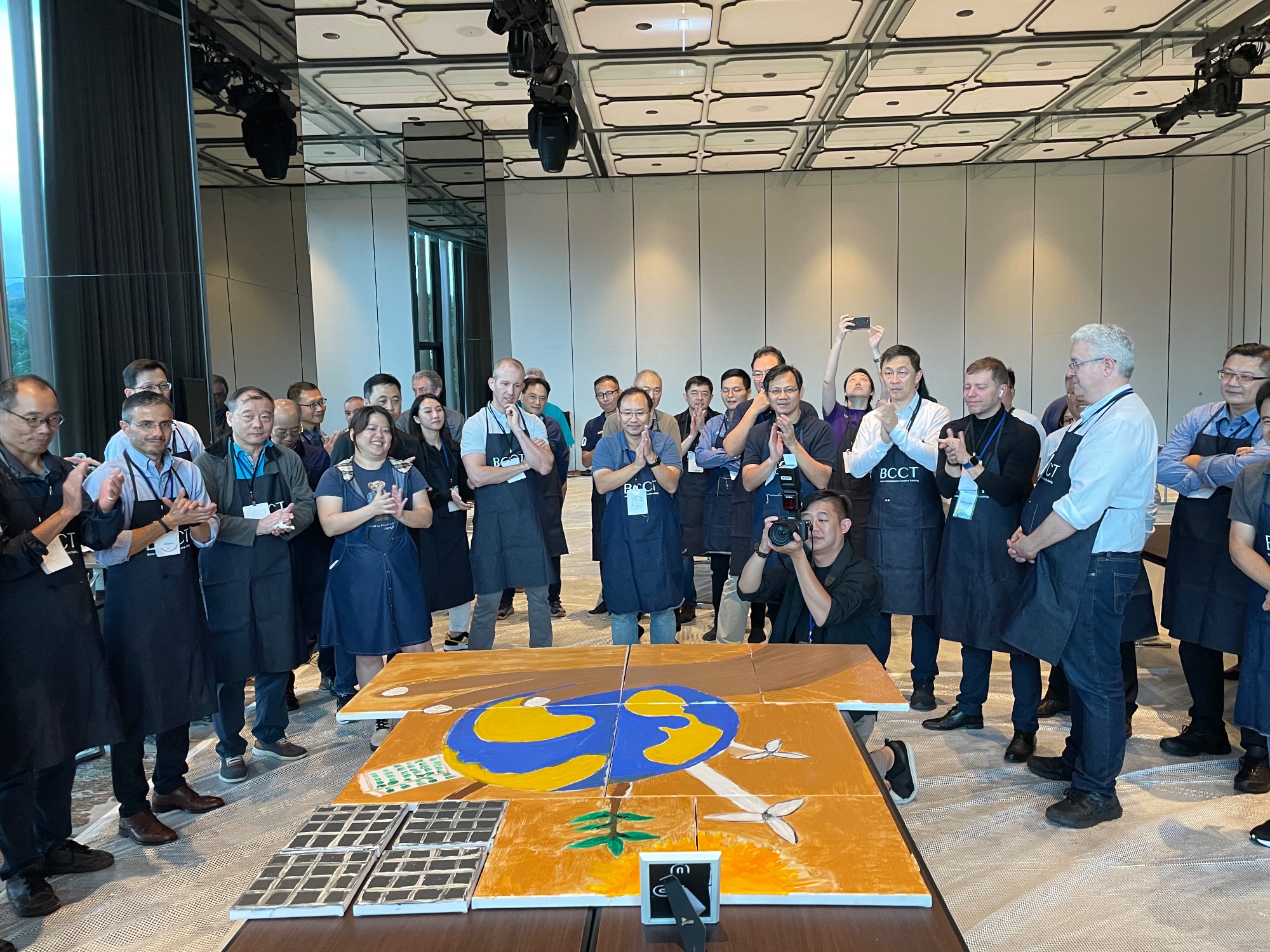
More importantly, this experience gets carried back into work. Once a team has felt firsthand what it's like to have "people on the same side, with the problem in the middle," the next time a real project issue comes up, they're more likely to remember: we're discussing this issue, not each other.
This Isn't About Anyone Doing a Bad Job
Back to that apartment building. The mother wasn't being unreasonable, and her relatives weren't out to make trouble. Each of them was simply expressing what they cared about in the way most familiar to them. The relatives cared about everyone's safety; the mother wanted her contributions to the family to be respected and recognized.
The same is true in companies. When a team can't focus on the issue rather than the person, it's often not because members are immature or managers don't know how to lead. It's simply human nature, and hard to avoid: people see the work they've done as part of who they are, and when they hear criticism, they protect themselves first.
So what needs to change isn't the people, but the way conversations happen. Give everyone a chance to change position, to go from face-to-face to side-by-side, and many things that once seemed stuck turn out to be not so hard to solve after all.